
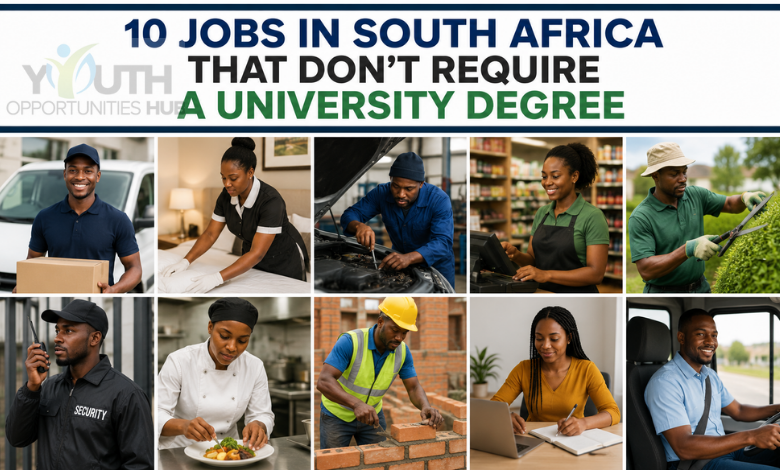
10 Jobs in South Africa That Don’t Require a University Degree
Not everyone can afford three or four years of tuition, and not every career needs a degree to get started. If you finished matric, or even if you left school before Grade 12, there are still solid jobs in South Africa that don’t require a university degree and can pay a respectable, sometimes excellent, salary. This list covers ten of them, what each role actually involves, how you qualify, and roughly what you can expect to earn.
These are not vague suggestions. Every entry on this list of jobs in South Africa that don’t require a university degree is a real occupation with a known training path, recognised by employers, recruiters, or a regulatory body.
Why So Many South Africans Are Looking at Jobs Without a Degree
South Africa’s unemployment rate stood at 32.7 percent in the first quarter of 2026, and youth unemployment among people aged 15 to 34 climbed to 45.8 percent. Even graduates are not spared. Over a million degree holders were unemployed in the same period, with general fields like humanities and business administration showing far higher joblessness than technical, artisan, and health related work.
At the same time, recruitment data from Pnet’s Job Market Trends Report shows steady, sometimes growing demand for roles that only require a matric certificate and the right practical skills, in sectors such as sales, construction, administration, and skilled trades. That gap between where the jobs are and where the degrees are is exactly why jobs in South Africa that don’t require a university degree deserve a serious look.
10 Jobs in South Africa That Don’t Require a University Degree
1. Electrician
Electricians install, maintain, and repair electrical systems in homes, businesses, and industry. You do not need a degree, you need a registered apprenticeship, TVET college theory, and a passed trade test leading to your Red Seal qualification. Electricians sit on South Africa’s National Scarce Skills List, which keeps demand high in construction, mining, and manufacturing. Entry point: Grade 12 with Mathematics and Physical Science, then an apprenticeship with a registered employer.
2. Plumber
Plumbers install and repair water, gas, and drainage systems, and the trade is in constant demand as housing and commercial developments continue across the country. Like electricians, plumbers qualify through an apprenticeship and trade test rather than a university programme. Experienced plumbers who go on to run their own small business can out-earn many office based graduate roles.
3. Boilermaker or Welder
Boilermakers and welders build and repair metal structures, tanks, and pipelines for mining, energy, and manufacturing clients. Training runs through a registered apprenticeship combined with TVET or private academy theory, ending in a trade test. Companies such as Steinmüller Africa regularly run structured boilermaking and welding apprenticeship intakes for school leavers with no prior experience.
4. Sales Representative
Sales roles, from junior sales assistant to trainee sales representative, are consistently among the highest paying entry-level jobs that only require a Grade 12 certificate. Pnet’s data puts market related salaries for sales representative positions between roughly R11,649 and R20,735 a month, which is well above many graduate starting salaries. Employers in this field generally prioritise communication skills, resilience, and a results driven attitude over formal qualifications.
5. Administrative Clerk
Every company, from a small logistics operator to a government department, needs admin clerks to manage records, correspondence, and office systems. This is one of the most accessible jobs in South Africa that don’t require a university degree, usually needing only a matric certificate and basic computer literacy. It is also a common entry point into larger organisations, with a realistic path into supervisory or coordinator roles over time.
6. Heavy Vehicle or Truck Driver
Truck driving is a straightforward example of jobs in South Africa that don’t require a university degree, since qualification depends entirely on licensing and a clean driving record rather than academic study.
South Africa’s logistics sector relies on qualified truck and delivery drivers to move goods between provinces and across borders. You need a valid Professional Driving Permit and the relevant licence code, not a degree, and many logistics and transport companies offer paid, structured driver training programmes. With freight and e-commerce delivery both growing, this remains one of the more stable, always in demand careers without a degree in South Africa.
7. Estate Agent
Selling property in South Africa does not require a university degree. Instead, aspiring estate agents must register with the Property Practitioners Regulatory Authority (PPRA), complete the required training, and obtain a Fidelity Fund Certificate before they can trade independently. Income is commission based, so it takes hustle in the early months, but experienced and top performing agents in strong markets can earn well into six figures a year.
8. Digital Marketing or SEO Specialist
Digital marketing, including search engine optimisation, social media management, and paid advertising, is a field where a portfolio and recognised certifications from platforms like Google, Meta, or HubSpot often carry more weight than a degree. Many specialists build their skills through short courses and hands-on freelance work before moving into agency or in-house roles. It is one of the fastest growing careers without a degree in South Africa, largely because businesses need results, not credentials.
9. Web or Software Developer
You do not need a computer science degree to become a working developer in South Africa. Coding bootcamps, industry certifications, and self-taught portfolios are widely accepted by employers, particularly for junior and mid-level roles, as long as you can demonstrate real projects. This is one of the few non-degree paths where remote work for international clients is realistic, opening up income in stronger foreign currencies.
10. Commercial Pilot
Becoming a commercial pilot has no university degree requirement at all. What you need is a Class 1 medical certificate, a Private Pilot Licence followed by a Commercial Pilot Licence, and the logged flying hours from a SACAA approved flight school. Training is a significant financial investment, and entry-level pay after qualifying is modest, often in the range of R19,000 to R45,000 a month depending on the operator and aircraft type, before climbing substantially with experience, aircraft type ratings, and seniority.
How to Get Started in a Job That Doesn’t Require a Degree
Finding jobs in South Africa that don’t require a university degree comes down to following a clear process rather than waiting for the right vacancy to appear.
Identify the entry requirement. Some roles need only a matric certificate, others require specific subjects like Mathematics and Physical Science, so confirm this before you commit to a path.
Choose the right training route. This might be a registered apprenticeship, a TVET college course, an industry certification, or a regulator-run programme such as the PPRA’s estate agency training or SACAA’s flight training.
Build a portfolio or logbook. Trades need a logged practical hours record for the trade test, drivers need permits and clean records, and digital roles need real, showable projects.
Apply directly and consistently. Search specifically for apprenticeships, learnerships, and entry-level roles rather than general vacancies, and keep applying even while training, since many employers hire before training is fully complete.
Frequently Asked Questions
Are jobs in South Africa that don’t require a university degree actually reliable careers, or just temporary work? Most of the roles on this list, especially the artisan trades, sales, and property, are recognised long-term career paths with clear progression, not stopgap jobs.
Do these jobs pay less than jobs that require a degree? Not necessarily. Several, including electricians, boilermakers, sales representatives, and estate agents, can match or exceed the starting salary of many general degree holders, especially once experience builds up.
Can I study part time while working one of these jobs? Yes. Many people start in an entry-level, no-degree role and study part time toward a diploma or degree later if their chosen field benefits from it.
Are these jobs only for school leavers? No. Several of these paths, particularly trades through Artisan Recognition of Prior Learning, digital marketing, and web development, are realistic career changes for adults with existing work experience.
Final Word
A degree is one route into the South African job market, but it is not the only one, and for many young people right now it is not the fastest or the most reliable one either. The ten jobs in South Africa that don’t require a university degree covered here span trades, sales, transport, property, technology, and aviation, giving you a genuinely broad set of options depending on your interests, budget, and timeline. Pick the path that matches your strengths, invest properly in the right training, and start applying.
Follow Youth Opportunities Hub via our official channels (just click on any link): Facebook, LinkedIn, WhatsApp Channel and Telegram
Looking for another opportunity?
Search Youth Opportunities Hub for jobs, bursaries, internships, learnerships, scholarships and more.

