
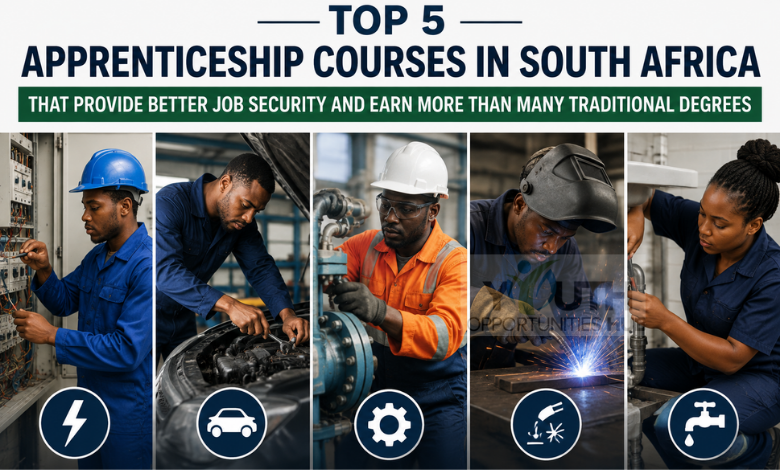
Top 5 Apprenticeship Courses in South Africa That Provide Better Job Security and Earn More Than Many Traditional Degrees
Two matriculants leave the same school in the same year. One enrols for a general BA. The other signs up for a registered electrical apprenticeship. Three years later, one of them is still job hunting with a stack of applications and a student loan. The other is earning a wage, holding a nationally recognised trade certificate, and getting called for overtime because employers cannot find enough qualified people in the trade. This is not a hypothetical extreme. It is the pattern behind a growing number of South African households choosing apprenticeship courses in South Africa over a general degree, and this article breaks down the five that make the strongest case, why they outperform many degrees on security and pay, and how to pick the right one.
Quick Answer: The Top 5 Apprenticeship Courses at a Glance
| Trade | Typical Duration | Entry Requirement | Typical Monthly Pay Once Qualified |
|---|---|---|---|
| Electrician | 2 to 3 years | Grade 12, Maths and Physical Science | Roughly R19,000 to R28,000 |
| Millwright | 3 to 4 years | Grade 9 minimum, strong Maths and Science preferred | Roughly R25,000 to R33,000 |
| Boilermaker | 3 years | Grade 10 to 12, technical aptitude | Roughly R15,000 to R25,000, higher on mines and shutdowns |
| Diesel Mechanic | 3 years | Grade 10 to 12, mechanical aptitude | Roughly R18,000 to R27,000 |
| Plumber | 2 to 4 years | Grade 10 to 12 | Roughly R15,000 to R24,000, more for the self-employed |
Figures vary by employer, province, and experience level, so treat these as realistic ranges rather than guarantees. What they show consistently is that a qualified artisan’s earnings can match or beat the starting salary of many general degree graduates, without the tuition debt.
Why Apprenticeship Courses in South Africa Outperform Many Degrees on Security and Pay
South Africa’s unemployment rate reached 32.7 percent in the first quarter of 2026, and youth unemployment for people aged 15 to 34 climbed to 45.8 percent. Graduates are not automatically protected either. Over a million degree holders were unemployed in the same period, and general fields such as humanities and business administration report noticeably higher joblessness than technical, artisan, and health related qualifications.
Apprenticeship courses in South Africa avoid three of the biggest risks in that picture. First, they are tied to a documented, structural skills shortage rather than an oversupplied graduate pool, since trades like electrician, millwright, and diesel mechanic sit on South Africa’s National Scarce Skills List. Second, apprentices earn a stipend from day one instead of paying tuition, which removes the debt burden that follows many graduates for years. Third, the qualification itself, the Red Seal Trade Certificate issued by the Quality Council for Trades and Occupations, is portable across employers, provinces, and much of the SADC region, so a change of employer rarely means starting over.
1. Electrician
An electrical apprenticeship is one of the most widely available apprenticeship courses in South Africa, training you to install, maintain, and troubleshoot wiring, circuits, and electrical systems in homes, businesses, and industrial plants. You register with an employer, complete theory through a TVET college or accredited provider, log your practical hours, and sit the trade test through the National Artisan Moderation Body. Entry usually calls for Grade 12 with Mathematics and Physical Science at around 40 percent or higher, since electrical theory leans heavily on both subjects. Once qualified, electricians remain one of the most consistently advertised trades in South Africa, and the skill opens doors into specialised, higher paying niches such as solar PV installation and industrial automation as renewable energy and factory upgrades expand.
2. Millwright
Millwrights install, maintain, and repair the industrial machinery that keeps factories, mines, and food and beverage plants running, combining mechanical, electrical, and fault-finding skills in a single trade. This is one of the longer and more technically demanding apprenticeship courses in South Africa, typically running three to four years and drawing on strong Maths and Science results, but it also tends to pay among the highest of the artisan trades once qualified. Millwrights are considered a scarce skill across manufacturing and mining, which keeps demand steady even when other sectors slow down. Reported monthly pay for qualified millwrights commonly falls between roughly R25,000 and R33,000, with senior and mine-based roles going higher.
3. Boilermaker
Boilermakers fabricate, install, and repair boilers, tanks, pipelines, and structural steelwork, and the trade leans heavily on welding and metalwork skill built up through the apprenticeship. Training runs through a registered employer combined with TVET or private academy theory, ending in a trade test, and companies such as Steinmüller Africa regularly run structured boilermaking and welding intakes aimed directly at school leavers with no prior experience. Base pay for boilermakers reported across salary trackers sits lower on average than millwrights, often in the R15,000 to R25,000 monthly range, but shutdown work, mine sites, and coded welding certification push experienced boilermakers considerably higher through overtime and specialised contracts.
4. Diesel Mechanic
Diesel mechanics diagnose, service, and repair the diesel engines that power trucks, buses, generators, agricultural machinery, and heavy earthmoving equipment. South Africa’s transport, logistics, mining, and agricultural sectors all depend on this trade, which is why companies from coal transporters to agricultural equipment dealers run their own dedicated apprenticeship intakes. Training typically runs three years, blending workplace experience with trade theory, and ends with the trade test for the Red Seal. Qualified diesel mechanics report typical monthly earnings in the region of R18,000 to R27,000, and the skill translates directly into self-employment for those who eventually want to run an independent workshop.
5. Plumber
Plumbers install and maintain water supply, drainage, and gas systems in residential, commercial, and industrial buildings, and the trade remains steadily in demand as housing developments, renovations, and commercial construction continue across the country. Apprenticeship duration for plumbing varies more than the other trades on this list, running anywhere from two to four years depending on the training provider and whether prior experience shortens the practical hours required. Qualified plumbers commonly report monthly pay between R15,000 and R24,000, though this is the trade with the clearest path to significantly higher, uncapped income for those who go on to run their own plumbing business.
Apprenticeship Courses vs a General Degree: The Comparison That Matters
| Factor | Typical Apprenticeship | Typical General Degree |
|---|---|---|
| Time to qualify | 2 to 4 years, earning throughout | 3 to 4 years, usually no income |
| Typical cost to you | Low to none, employer funded | R150,000 to R400,000+ in fees and living costs |
| Debt on completion | Usually minimal | Often substantial student debt |
| Link to a skills shortage | Direct, trade appears on scarce skills lists | Depends heavily on the specific degree and field |
| Portability | Recognised nationally and across much of SADC | Varies by institution and profession |
This comparison is not a case against university. Regulated professions such as medicine, engineering, and law still require a degree by law, and specialised, in-demand degrees continue to perform well in the job market. The point is narrower. Where the alternative is a general degree with no attached occupation, apprenticeship courses in South Africa in a scarce trade frequently offer better odds of steady employment and comparable, sometimes better, early career pay.
How to Choose the Right Apprenticeship for You
Choosing between the various apprenticeship courses in South Africa comes down to matching the trade to your interests, results, and long-term goals rather than picking whichever one is advertised first.
If you enjoy hands-on problem solving over classroom theory, look at diesel mechanic or boilermaker first, since both reward practical troubleshooting skill. If you want the highest ceiling on technical complexity and pay, and you have strong Maths and Science results, millwright is worth the longer training period. If you want the broadest national demand and a realistic path into specialised, higher paying niches later, electrician is hard to beat. If independence and eventually owning your own business appeal to you more than working for a large employer, plumbing offers the clearest route to that outcome. Whichever trade you choose, apply directly to registered employers advertising apprenticeships rather than general vacancies, and treat your logbook of practical hours as seriously as any exam, since it is what ultimately gets you to the trade test.
Final Word
A degree is still the right choice for some careers, but it is no longer the automatic safest bet it once was in South Africa’s job market. The five apprenticeship courses in South Africa covered here, electrician, millwright, boilermaker, diesel mechanic, and plumber, each combine real job security, a debt-free path to qualification, and pay that can match or beat many general degrees. Pick the trade that fits your interests and strengths, apply to a registered employer, and start earning while you train.
Follow Youth Opportunities Hub via our official channels (just click on any link): Facebook, LinkedIn, WhatsApp Channel and Telegram
Looking for another opportunity?
Search Youth Opportunities Hub for jobs, bursaries, internships, learnerships, scholarships and more.

