 Youth Opportunities Hub Internships, Learnerships, & Career Development

Development Innovation Ventures programme: DIV Fund Up to US $200,000
The DIV Fund is accepting rolling applications from organisations working on cost-effective, scalable solutions to development challenges across low- and middle-income countries. Structured as a three-stage funding model, the DIV Fund offers grants ranging from $200,000 at the pilot stage up to $1.5 million for proven innovations ready to scale, backed by a rigorous, evidence-driven review process.
For African social enterprises, nonprofits, and startups with a tested, real-world solution already in use, this is one of the more substantial funding pathways currently open, provided your innovation fits the Fund’s specific criteria.
About the DIV Fund
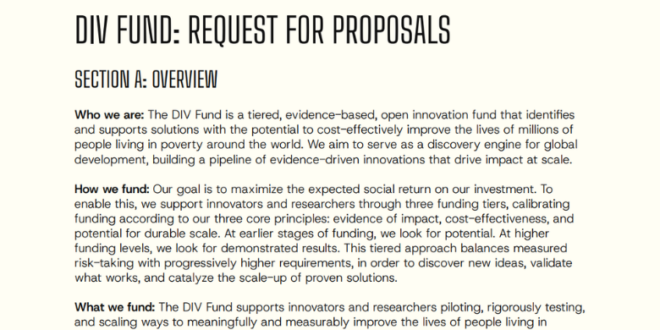
The DIV Fund positions itself as an R&D engine for development, combining risk-tolerant capital with evidence-driven decision-making to back bold ideas, test what actually works, and scale the most cost-effective innovations. Every application is assessed against three core principles: evidence of impact, cost-effectiveness, and durable potential for scale, with expectations under each principle adjusted depending on the funding stage applied for.
The Three Funding Stages
Stage 1: Pilot — Up to $200,000
Stage 1 grants support real-world pilots of promising innovations, used to test user demand, feasibility, impact potential, and financial viability. By the end of Stage 1, the DIV Fund wants clarity on whether the innovation works in practice, whether people will actually use it, and whether it shows enough promise to justify deeper investment.
Stage 2: Test & Position for Scale — Up to $500,000 (up to $750,000 in exceptional cases)
Stage 2 grants determine whether an innovation is measurably impactful and has a viable path to growth. These grants may fund rigorous impact evaluations, market validation, testing of new business models, or assessment of scale readiness. By the end of Stage 2, the Fund wants to know whether the innovation significantly improves lives, is cost-effective, and has a clear model for scaling.
Stage 3: Scale — Up to $1.5 Million
Stage 3 grants accelerate the scale-up of validated, transformative innovations. To qualify, applicants need to demonstrate strong evidence of impact and cost-effectiveness, or commercial viability, and show how they will leverage external partnerships to drive widespread adoption. By the end of Stage 3, the Fund wants confirmation that the innovation can achieve sustained impact at scale without ongoing grant dependence.
Important: Applicants do not need to progress through the stages sequentially. You can apply directly for the stage that matches your innovation’s current level of maturity, though later-stage applications must credibly demonstrate that earlier-stage criteria have already been met.
Who Can Apply?
The DIV Fund accepts applications from most organisation types, including nonprofits, social enterprises, startups, private-sector firms, universities and research institutions, technical assistance providers, and consortia, whether locally led or global. The Fund supports innovations addressing challenges in low-income, lower-middle-income, and upper-middle-income countries, in line with the World Bank’s income classification.
A few important restrictions apply:
- The Fund does not fund initiatives implemented exclusively in high-income countries
- The Fund cannot provide funding directly to individuals without a legally incorporated entity
- The Fund cannot fund government agencies directly
What Gets Funded, and What Doesn’t
What the DIV Fund May Support
- New technologies
- Policy innovations
- Social or behavioural innovations
- New business models, or new ways of delivering or financing goods and services
- Cost-effective adaptations to existing solutions
- Data collection and rigorous evaluation of promising innovations
- New approaches to increasing uptake of highly effective solutions, including replication and scaling to new locations
- Replication studies confirming prior impact evaluation results in new settings
What the DIV Fund Typically Does Not Support
- Innovations still at the idea stage that have not yet been built (pre-prototype)
- Projects with limited potential to scale cost-effectively, such as construction of immovable physical infrastructure
- Basic scientific research with no field testing
- Standalone planning, diagnostic, or monitoring tools that are difficult to link directly to measurable development outcomes
- Intermediaries with only an indirect impact on development outcomes, such as incubators, accelerators, or start-up boot camps
- Innovations applicable only in very limited contexts that restrict their ability to scale
- Research that demonstrates impact but does not assess cost-effectiveness or scalability
- Innovations that primarily target high-income beneficiaries
A critical eligibility rule: the DIV Fund only supports innovations that are post-prototype, meaning they have already been tested or used in a real-world setting. Ideas still in a lab or at concept stage, including for Stage 1 applications, are not eligible.
Pathways to Scale
Applicants must identify how their innovation is designed to scale, since this shapes how the application is evaluated:
- Public pathway: scaling through government, donor, or philanthropic funding
- Commercial pathway: scaling as a business, financed through customer payments, advertising revenue, or similar commercial models
- Hybrid pathway: scaling through a combination of commercial revenue and public or philanthropic funding
Choosing the pathway that genuinely reflects your innovation’s model, rather than the one that sounds most appealing, strengthens your application significantly.
How to Apply
- Read the Request for Proposals in full before applying, since it details exactly how proposals are evaluated at each stage
- Complete the application, submitted through the DIV Fund’s online application portal. Applicants may download the application form as a PDF or editable Word document to prepare offline first, though final submission must happen through the website
- Application Review: eligible applications are assessed against the Fund’s core criteria, including strength of the innovation, potential for scale and financial sustainability, expected impact, cost-effectiveness, and the capacity and strength of the applicant team
- Diligence: promising applications move into a more detailed review phase, where the DIV Fund team and external reviewers evaluate risks, refine impact and cost-effectiveness assumptions, and clarify the path to scale
- Decision Panel: funding decisions are made by expert panels convened several times per year, which may include requirements to strengthen aspects of the proposal before funding is confirmed
- Pre-award: successful applicants move into a milestones-based grant structure, with financial due diligence and finalised budgets and agreements
Applications are accepted on a rolling basis throughout the year, so there is no fixed annual deadline to work around.
Visit the official website to apply
What to Expect on Timeline
The full process, from initial submission to final funding decision, generally takes several months, with later-stage proposals requiring more extensive diligence than early-stage ones. If selected for funding, expect roughly one additional month of due diligence to finalise the grant agreement. All applicants receive a decision by email, regardless of outcome.
A Note on AI-Generated Applications
The DIV Fund is explicit that it reserves the right to decline proposals without comment if they appear incomplete, ineligible, duplicative, or primarily AI-generated. While thoughtful use of AI tools by applicants is accepted, proposals must reflect genuine human judgment, context-specific insight, and clear ownership of the ideas presented.
Final Thoughts
For organisations with a genuinely tested, real-world innovation ready to demonstrate impact, cost-effectiveness, and a credible path to scale, the DIV Fund offers a substantial and structured funding pathway, from a $200,000 pilot through to $1.5 million in scale-up capital. Because applications are accepted year-round, the most important next step is reading the full Request for Proposals carefully and identifying which of the three stages genuinely matches where your innovation stands today.